2025
2023
2025 FESTIVAL
A Cinema to Hold in the Hand:
Notes on the 7th Annual Cosmic Rays
By Genevieve Yue
In Caryn Cline’s Something Went Click, an image of a woman plays on repeat. Her left hand twists against her temple as though turning a key. The image is interrupted by blotches of color, scratches, and unusually placed sprocket holes, all evidence of a film worked over painstakingly by hand. The woman explains the gesture: it signals the moment in which her manic depression first appeared. “You knew that something was different,” the filmmaker says to her mother. “Oh boy,” she replies, “did I ever.”
There is also something different about Cosmic Rays, a film festival in Chapel Hill, North Carolina dedicated, in its own words, to “expanding our idea of what film is and what it can be,” and now in its seventh year. There are, of course, plenty of small, regional film festivals dedicated to experimental form. But among these, in five compact programs screening over a weekend, Cosmic Rays is unusually attentive to the politics and poetics of the handmade, a practice that film scholar Gregory Zinman has described “as an attempt to reinscribe the human within a field of machines and convey a similar set of anxieties about—and at times direct protest against—the perceived artificiality of digital imagery.”1
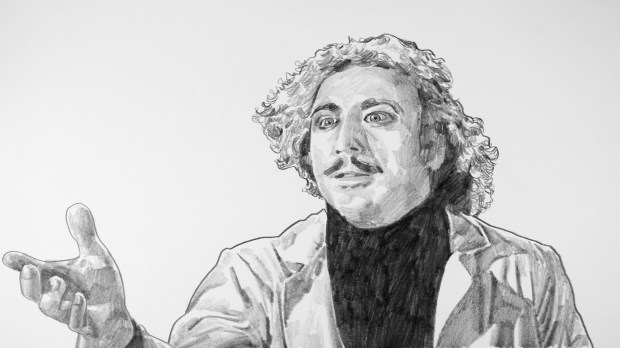
The handmade abounds in the methods, textures, and attention organized in the festival’s program of nearly 40 films. It can be felt in the pencil smudges that recast rotoscoped actors into exceedingly sensitive portraits in Karen Yasinsky’s I’m Not Your Monster; the anarchic glee of Ella Berke’s Cherry Pie, which depicts a woman eating a slice of the titular pie off another’s belly; the superimposed imagery in Kamila Kuc’s I Was There, which layers the past over the present like the dresses, once belonging to her grandmother, that are now worn by the filmmaker; and the mirrors and baubles that glimmer in the sunlight in Baba Hillman’s Mary Bauermeister: light and stone. It is also in the simple gesture of setting up a portable screen in the middle of the woods, as Craig Scheihing did for sunspots, burnt into my heart, where shadows play on its surface and a pair of flowers bop gently against it, prompting the question: are they watching the film, or are they a part of it?
For some, the handmade may conjure an earlier period of avant-garde film activity—think the hand-painted films of Stan Brakhage or the photogram technique of Man Ray. But it is shortsighted to assume that handmade films are only about film, or only the past. Many of the works employ digital techniques. Laura Kraning used a malfunctioning inkjet printer that produced ghostly horizontal streaks to make ESP, a title that stands for Empire State Plaza, a large municipal complex in Albany, New York. The printer’s extra lines intersect with those of the modernist towers, and through the rapid alternation of frames, they create a kind of ecstatically animated plaid. With Exo Gestus #2, Yvette Granata also used the limitations of a technology to create a film. She wore a poorly fitted motion capture suit, then assembled the device’s interpretation of her misrecognized body into an uncanny ballet, a trio of dancers whose limbs readily detach and recombine against an empty landscape reminiscent of the paintings of Yves Tanguy. AI is present in the festival as well. But in Jacklyn Brickman and Sharon Gill’s Speculative Speciation: Passenger Pigeon, it is employed to revivify an extinct species of bird to imagine what new creatures might have emerged from its genetic line. The film’s illustrated style and vignetted frame is reminiscent of magic lanterns displays, an 18th and 19th century precursor to projected film. Beyond its avian subject, the film suggests genealogical paths not taken for film, as well.
Miranda Pennell’s Man Number 4, meanwhile, offers a startling investigation of a digital image in the tradition of Jean-Luc Godard and Jean-Pierre Gorin’s Letter to Jane (1972) or Ken Jacobs’s Tom Tom, The Piper’s Son (1969). At first, we see only large, pixelated blocks. The voiceover, which speaks in the second person, admits “you have trouble understanding what you’re looking at.” The cursor is visible, an arrow that points to what the filmmaker scans, and what the voice verbalizes. Pausing on a patch of color, he murmurs, “hospital green… man number 4 is a doctor.” Gradually the view pulls back. The pixels shrink, and more is apparently visible. But at what cost? A horrific scene of a mass of prisoners, some of whom are doctors, emerges. The filmmaker’s own scene of viewing also enlarges; she puts on music. This image, the voice reveals, had been posted on social media in December 2023 and identified by users as Beit Lahia, a city in Gaza. Man Number 4 is Dr. Khalid Hamoda, whose family had been killed before this photograph was taken, and whose current whereabouts remain unknown. What is it to observe this image with Mozart playing in the background? What is an appropriate distance?
A. S. M. Kobayashi also attends carefully to the object in File No. 2304, named for the government record kept on the filmmaker’s great-grandfather, who had, with other Japanese-Canadian citizens, been involuntarily interned during the Second World War. Kobayashi briskly scans through microfilm that itemizes objects seized from the household: toys, a dining table, a stuffed pheasant. “The Kobayashis were robbed by bureaucrats,” she reflects. “Their dispossession was neatly organized in memorandums, diagrams, forms, reports, and charts.” From within the cold rationalization of racist persecution, the filmmaker reconstructs something of a family history. She looks to recognizable ear shapes in photographs, a child’s harmonica that might have been the same as one that belonged to her aunt, and matches them to their present day manifestation: the site of the family home, now a parking lot, and her smiling aunt with a harmonica pressed to her lips. In revealing how a family’s history was translated into typed numbers and letters by the state, and filed away in a vast archive, Kobayashi also offers possibilities for its retrieval, its surprisingly vivid details still intact, if you know how to look.
Several films approach the landscape through a sense of touch. Kara Ditte Hansen’s Semi-Precious gathers stones, crystals, herbs, and other materials, assembling them in an associative montage, just as her naturopath mother, the subject of the film, labels and explains them. Susanna Wallin’s Lizzy, spurred by the death of a reclusive neighbor and their enigmatic gift of an electric organ, explores the transformation of a home as it becomes rubble amid the alligators and algae blooms of the Hillsborough River in Florida. Alina Orlov’s The Calvary, about the calvary unit of the Israeli Defense Forces, uses touch to suggest an unseen regime of violence and submission. “Horse Number 7” (a name which unintentionally rhymes with the imprisoned doctor in Man Number 4), is trained to stay still as it is battered by an inflatable stick figure, the kind seen on used car lots, lowered onto the horse’s body by its trainer. J. M. Martínez’s Species of Analogy, meanwhile, captures sound with a geophone, a microphone normally used to record seismic activity, to produce a tactile sense of flower buds, petrified trilobites, and seeds grasped in someone’s palm. The film subtly inverts the human frame of reference with a citation from Vertigo (1958): where a visit to the Muir Woods in Hitchcock’s film prompts Madeleine to reflect on her own insignificance compared to the lifetime of a fallen redwood, here nature speaks back to her: “it was only a moment for us, we took no notice.”
The touch of the hand is also present in John Winn’s affecting Ode to R.G. Springsteen, a diary film of the filmmaker’s unassuming, solitary life. Each vignette begins similarly: the filmmaker opens a window, sweeps, reads a few pages of a book, or lays down a plate on a table. Then the sound of Springsteen’s voice blows into the space, like the wind that enters through the patio doors. Springsteen, a director and actor of B-westerns, cajoles, menaces, and even sings as Winn shuffles through household chores, momentarily enchanting them. In his note for the film, Winn explains that these were dispatches sent to a friend, a fellow cinephile. This film, I think, partakes of the reason why a film festival like Cosmic Rays exists, and why so many people, from the programmers to the filmmakers to the audience members, put in extraordinary amounts of time and labor to make it happen every year. If we let it, cinema can bring fresh air into the mundane. It can reorient us to the shifting vectors of the world around us. And best of all, we can share it, like letters passed among friends.
- Gregory Zinman, Handmade Cinema, 5. ↩︎
2023 FESTIVAL
Space Ways: 2023 Cosmic Rays Film Festival
This article appeared in the April 6, 2023 edition of The Film Comment Letter, our free weekly newsletter featuring original film criticism and writing. Sign up for the Letter here.
By Leo Goldsmith on April 10, 2023
In the discourse about the pandemic’s effects on moviegoing and the latest death of cinema, there has been scarcely any mention of the plight of emphatically noncommercial modes like experimental film and video or artists’ cinema. The very terms, after all, suggest that no good capitalist should care: why wring one’s hands over the fate of cinema at the margins, whose makers aren’t even trying to secure Netflix deals? But in fact, artists’ cinema has been enjoying something of a resurgence. Recent years have seen a host of new online initiatives, from e-flux’s video platform and the Prismatic Ground film festival to niche meme accounts, which provide access to objects once largely inaccessible to the general public. Meanwhile, there’s a growing hunger for cinematic experiences that resist compatibility with digitization and internet exhibition, meaning that experimental film screenings routinely sell out at museums and microcinemas alike.
The small, regional experimental film festival—the classical site for alternative film exhibition since the mid-century avant-garde period—in particular seems to have emerged stronger from the pandemic. Over a spring weekend this past month, the itinerant American cinephile had the luxury of deciding between three simultaneous showcases in disparate corners of the country: Onion City Experimental Film Festival in Chicago; Light Field in San Francisco; and the Cosmic Rays Film Festival in Chapel Hill, North Carolina. The last of these, curated by artist-filmmakers Sabine Gruffat and Bill Brown, launched in 2018, and is a relative newcomer. Realheads will note that the festival’s name is a nod to the 1962 Bruce Conner film Cosmic Ray—a lysergic paean to Ray Charles and a prime example of Conner’s high-octane montage. But as a university-centered festival that cultivates both a regional and an international network of filmmakers, curators, cinephiles, and critics, Cosmic Rays also gestures, with its name, to more plainly scientific associations, like the atmospheric disruptions from space that bridge planes of wildly divergent scales. Its reach is interstellar and terrestrial, global and local.
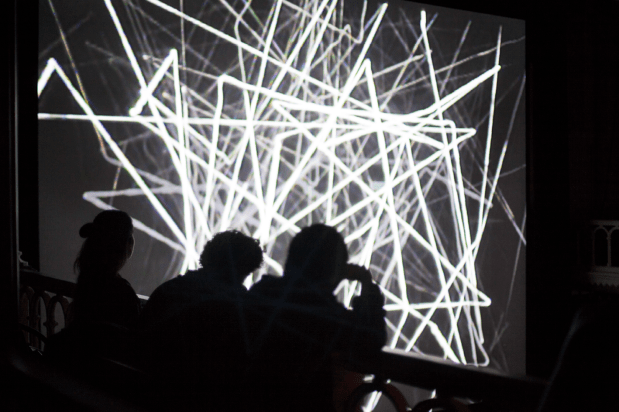
On opening night, Cosmic Rays offered a selection of three live projection performances, staged at a concert venue named Cat’s Cradle. Ephemeral, abstract, and often very, very loud, these sets afforded a look under the hood of a wide spectrum of analog and digital technologies, which the performers hacked and manipulated in real time. Tomonari Nishikawa’s Six Seventy-Two Variations (an earlier iteration of which the artist performed in the Currents section of the New York Film Festival in 2021) was the most minimalist of the three, consisting of a projection of a loop of clear 16mm leader, to which Nishikawa added a steady accumulation of scratches. As the performance unfolded and the artist’s jagged engravings filled the frame, the projector’s optical sound sensors registered them as awkward ka-chunks which gradually coalesced into a pulsating off-rhythm. At the other technological extreme was Jon Satrom’s dizzying and frequently hilarious screen-share performance, Prepared Desktop, in which the artist ran simple scripts to exploit the basics of the Mac OS interface—including many of its familiar functions, alert sounds, and text-to-speech voices—in subtle, then wildly maximalist ways. Somewhere in the fuzzy middle of the analog-digital divide, Jonas Bers’s ΔV/ΔT—named for the acceleration formula—made use of an oscilloscope, two video mixers, and a mad scientist’s bank of knobs and wires. Bers sculpted waveforms into undulating monochrome blobs to produce an electronic cacophony, conjuring a sense of (controlled) danger as he explored the thrilling polarities of signal and noise.
The core of the festival lay in its four programs of short films—none of which, in accordance with submission guidelines, exceeded 15 minutes. Like the live sets, many of these works saw their makers exploring a range of media technologies and the ways in which they shape their subjects, be they human and animal bodies, urban and natural spaces, or history and politics. This approach was clearly evidenced by the festival’s sole single-artist program, devoted to a trilogy of recent films by Suneil Sanzgiri. Collectively dubbed Barobar Jagtana, the suite investigates past and present liberation movements of India—in Goa, Kashmir, and the diaspora—and traces their transnational reverberations. Sanzgiri exploits cinema’s ability to reconstruct time and space nonlinearly with an arsenal of techniques—analog film and desktop interfaces, oral history and poetry, animation and drone footage—to unsettle our geographic and historical orientations and gesture at new solidarities.
Elsewhere, Nicolas Gebbe’s (perhaps too obviously titled) Lockdown Dreamscape deploys photogrammetry to stitch pictures of his apartment into a seemingly endless digital maze, a synthetic long take that winds through the oozing architecture and deliriously mutable bric-a-brac of his home. Similarly, Kelly Sears’s Phase II uses collaged photos of city skylines alongside voiceover narration to relate a speculative fiction about gentrification and urban control in a near-future Denver. Sears’s subtle blend of science fiction, street photography, and animation techniques anticipates the dystopian world-building of real estate, constructing a cityscape where loudspeakers sprout on poles like malevolent flowers alongside proliferating condo buildings, enacting sonic warfare on local populations in the name of endless development.
Film editing is itself a kind of technology for the construction of new spaces, temporalities, and modes of consciousness. True to the festival’s namesake, several films screened there employed found-footage aesthetics in the lineage of Conner, albeit with an emphasis on the oneiric, dissociative assemblages of his later works like Take the 5:10 to Dreamland (1976) and Valse triste (1977). Among the best of these, Alina Taalman’s Prearranged Signal interweaves a rich catalog of images and sounds, cutting from 16mm footage of vegetation and rippling seas to scenes of lonely women and suburban homes from old movies. Amid a soundtrack of sinister electronic noise and droning field recordings of nature, a voice asks, “Do you know what the signal is?” Taalman’s film stages the act of interpretation itself—that alternately uneasy and thrilling task of locating meaning within a roiling ocean of media sensations. Prearranged Signal, which opened the final program of the festival, felt in harmony with Cosmic Rays’s curatorial remit: an invitation to draw unexpected connections across technologies, beyond genres, and between images.
Leo Goldsmith is a Visiting Assistant Professor of Culture and Media at Eugene Lang College of Liberal Arts, The New School, and a programming advisor for the New York Film Festival.
 Cosmic Rays Film Festival